
My first Bible lessons were taught in 2-D — flannel storyboards with cartoonish paper-cutout versions of Queen Esther and baby Jesus. Everyone in the Bible was white, a generic Eastern European shade of nude, and everyone moved across the same flat plane of the flannel board.
Jesus’ resurrection had to make the jump into a multidimensional world and come alive in my imagination. Where was the Jesus who ate with sinners and threw shade at the religious leaders of the day? What was it like to see people healed from blindness and disease? What did people whisper when they realized that an unclean, bleeding woman had walked freely in the crowd, only to be healed and called “daughter” by Jesus? What did Jesus mean when he said he could feel the power leave his body?
Very few people in my childhood seemed interested in asking those questions. Instead, I was encouraged toward a type of blind faith that claimed belief in miracles but was insufficient to help me explore how mind, body and spirit are real and interrelated.
Yet I was curious, and I hungered to connect my mental, physical and spiritual experiences both inside and outside the church. The yearning intensified as my children reached school age and the physical demands of parenting shifted, giving me time and space to feed my craving for both prayerful stillness and vigorous activity. I would go from praying silently over coffee to sweating in a cardio class with a pounding bass line and loud encouragement from the instructor. At church, I would murmur the Lord’s Prayer while planted in the pew, only moving to greet others during the passing of the peace.
And then yoga came to me.
This is a common phrase among practitioners of yoga, and it is similar to the way evangelicals describe their conversion stories: God chases after us — God comes to us — and then we find God.
The schedule at the gym had changed, and yoga was available when I usually exercised. It felt strange for me to be invited in a gym to sit quietly, to listen to my breath and to try to silence the voices in my head that demand attention. We are invited to do this at church for moments, but not for an entire hour.
Yoga has now been a part of my physical and spiritual disciplines for almost a decade. The loud, bass-driven soundtracks to weight training, kickboxing and other cardio classes remain, but over the years they have taken a back seat to yoga.
The challenge of confining myself to a small space and maintaining silence was not new. As a Christian, and particularly as an evangelical, prayer — usually silent — is meant to be a daily practice. Though not confined to a physical mat, “quiet time,” the practice of praying alongside reading the Bible, is meant to be done in the still of the morning, before the busyness of the day. If I could pray in my head and listen to God in silence, why was I so afraid to listen to my breath?
Some of my evangelical friends were curious and concerned about the Eastern religious roots of yoga. But perhaps because I am Korean-American — a child of immigrants whose folk medicine and cultural traditions do not mirror those of the Western evangelical church — I was less concerned about inviting evil and more concerned that my U.S.-centric faith had lost some of the spiritual formation practices familiar to Jesus.
My yoga practice continued to evolve, not only in the physical poses, but in the way my soul and body craved the centering, peace and stillness that came first in being on the mat and then transferred into my daily life. When I lost my breath as I moved through my day — became lost in my mind — I learned to stop and notice, quiet the thoughts and self-critique, and be present to God.
The yoga practiced in the U.S. is not unlike our brand of embodied faith. It is limited. It is deeply influenced by Western values and norms. There is a movement in the American yoga world to make sure it is accessible to a diversity of people — diverse in race, ethnicity, gender, class and body type.
The conversations among yoga teachers about diversity, influence, access and power are not that far removed from those happening in evangelical spaces. Being deeply invested in those conversations pushed me to pursue training as a yoga teacher, with the aim of deepening my physical and spiritual practices both on and off the mat and somehow translating those into my Christian faith and my experience in the pews.
I wondered about my faith and how I articulated and embodied my evangelical beliefs as I sat through my first training session — 10 days with 10 strangers learning not only about the asanas, the physical poses most people associate with yoga, but also about meditation, energy fields within and outside the body, and the philosophy of nonviolence to oneself and the world.
I’ve been an evangelical and an American long enough to know that plenty of people see yoga only as exercise or an excuse to wear spandex, while others see it as a gateway to Hindu worship. I don’t want to remove completely the cultural and religious roots of yoga, but I am not yet sure what that will mean in practice. I grew up with folk and Eastern medicine. For instance, after childbirth, I was told not to drink or touch anything cold, because my body was “hot” — even as my parents and in-laws prayed Christian prayers over my newborns.
What are those clear lines between Christian and non-Christian when your culture intersects worlds Western evangelicalism doesn’t even imagine? I wasn’t sure what to think about chakras, the seven basic energy fields within the body, but as a Christian who says she believes the power of the Holy Spirit moves through and in me, was it such a stretch to consider that there were fields of energy I did not see or understand?
So I’m training to become a yoga teacher with no set plans about what that means, except to return to my breath, my body, my faith.
One of my favorite jokes, particularly during the period when I served in a parish, tells of a pastor who is in her office, head bowed and hands folded in silent and fervent prayer.
The church administrator walks in the office door without knocking, sees the pastor and sighs in relief, “Oh, good. You’re not busy.”
The wry smiles that this joke would often elicit when I told it to fellow clergy testify to the odd disconnect that many pastors face in the perception of their work by people in their congregations.
The very practices (prayer, slow study, contemplation) that tend to sustain a healthy pastorate are often the activities least likely to seem like “real work” to many parishioners.
To the extent that this disconnect is present in a congregation’s relationship with its pastor, it can have an impact on a number of areas related directly to the pastor’s health (compensation, expectations for weekly schedule, hours worked, self-care) and to the congregation as a whole (spiritual development, sense of Christian mission, support for paid and volunteer leadership).
One of the places this shows up is in clergy sabbaticals. It’s becoming more common for pastors to take sabbaticals of several months or more. But conversations between pastors and their congregations around the topic have the potential to become fraught if the congregation and pastor are on different pages as to what sabbatical is for — and indeed, who it is for.
In my work directing the Lilly Endowment Clergy Renewal Programs (which Christian Theological Seminary administers on behalf of the endowment), I speak to many pastors who are raising the possibility of taking a pastoral sabbatical for the first time with their congregations.
One of the most common objections from congregants is, “Why does the pastor get a sabbatical when I don’t? I work just as hard at my job.” This, along with the parallel suspicion that “sabbatical” is code for “the pastor gets a three-month paid vacation,” is a challenge.
But it’s also a shared learning opportunity for pastors and congregation members. How can the understandable resistance to the practice of clergy sabbatical be addressed nondefensively in ways that minimize rather than exacerbate the clergy-lay disconnect?
We might think differently about how we emphasize the distinctiveness of ordained ministry vis-à-vis other vocations. One historic way to justify pastoral sabbaticals has been to point out the unique challenges of congregational ministry.
Weekly sermons, walking with parishioners in the most emotionally intense periods of their lives, community outreach, being on call around the clock — excellence in ministry requires a massive expenditure of physical, mental and emotional energy each week.
So the case can certainly be made that pastors are uniquely positioned to benefit from time to replenish their spiritual care, revitalize key relationships, go deeper into a theological passion or avocation, or any number of activities characteristic of a quality pastoral sabbatical.
“Uniquely positioned” is not the same as “uniquely deserving,” however, and here is where my thinking on this question has evolved. In an increasingly post-Christendom church, and within a frame that values the practice of Sabbath and renewal as one that encompasses all Christians, it seems wiser to me to step back from emphasizing the distinctiveness of the pastoral vocation.
Instead, it’s fruitful to focus more on how pastoral sabbaticals can catalyze the entire congregation toward renewal. The attitude should be less “being a pastor is a harder job than yours” and more “the church should encourage sabbaticals for everyone.”
I recommend framing the conversation around the question, How can a successful pastoral sabbatical, one that involves the entire congregation, model what it means to make regular periods of renewal a part of the Christian life?
The former strategy broadens the clergy-lay disconnect, while the latter helps close it in constructive and nondefensive ways.
What might this look like?
Walter Brueggemann has spoken of the Sabbath as “resistance” to the culture of excess work and consumption that plagues much of Western society. With the frantic pace of multiple obligations (work, family, health, etc.) faced by many congregants, I hear an increasing number of pastors say that they find it helpful to actively advocate (and, if possible, experiment with creative ways of fostering) similar, sabbatical-like renewal experiences for their church members.
For instance, while lay leaders may need to “step up” and take on more responsibility during a pastoral sabbatical, the congregation might consider intentionally blessing time away from active service for those leaders after the pastor returns.
The leaders might use the “sabbatical” from volunteer church responsibilities to pray, spend quality time with families, etc. — all with an eye toward coming back refreshed and re-energized for their vocations in the church and broader community.
Moreover, with more Americans than ever moving between careers on a regular basis, congregations are in a position to help members conceive of times between jobs as times to retool spiritually and move deeper into the practices that will sustain them, not simply as workers in the economy, but as children of God.
We know already that the more invested the congregation is in the pastor’s sabbatical and the more the members see it as a journey for the entire congregation, the more successful the experience.
If this can be extended, and Christian congregations become advocates for the practice of sabbatical across the American economy, the effects can be significant and deeply humane.
If theologian Sarah Coakley had one message about power for Christian institutional leaders, it would focus on “the power that comes through transparency to the divine.”
In an interview on living prayer and leadership, Coakley, the Norris-Hulse Professor of Divinity at the University of Cambridge, said such empowering transparency is cultivated best through an intentional life of prayer.
“Often even ministers don’t think enough about how Christian life is magnetized and electrified by being lived prayerfully,” she said. “When you meet a priest or a minister who is living prayer, you never forget that person. That person may be bumblingly inefficient on the budget, useless about remembering to come to appointments, all other kinds of things that they’re meant to do right, and yet have the most fantastic impact on people’s lives. …
“Prayer has to be at the top of the list of what we’re training people to do in ministry.”
Most seminarians study various forms of prayer. But once they are immersed in congregations or other institutions, the distractions and busyness of the work make it more difficult for them to be leaders who are “living prayer” — “magnetized and electrified” by an intentional practice of prayer.
As a result, institutional leaders hunger for simple, effective ways to support their spiritual lives. They ask: How can we feed ourselves while also feeding others?
For these leaders, praying with beads is a practice worth trying.
This calendar year, I’ve been experimenting with the practice of praying with beads. Twice a day, whether I am at the office, at home or traveling, I take my prayer beads out of my bag — and a sense of calm and focus comes over me.
As I finger my prayer beads, crafted out of blue stone beads from New Hampshire, a Russian bead from a friend and beads from one of my mother’s old necklaces, I am able to get in the “zone” of prayer, despite the fragmentation of my day. I have come to look forward to these centering moments.
My practice started in Lent, when I was seeking to grow by trying a new spiritual discipline. Making prayer beads and praying with them combined my love of art with my love of spiritual practices. I had several boxes of old beads and another full of old necklaces waiting to be upcycled. And I remembered my Roman Catholic grandmother years ago having a rosary. Exploring Protestant prayer beads seemed to be an act of traditioned innovation for me.
Prayer beads offer a variety of ways to pray. I started with Kristin Vincent’s ideas in “A Bead and a Prayer: A Beginner’s Guide to Protestant Prayer Beads.” Vincent suggests making a circle of 33 beads representing the life of Christ, along with an invitation bead and a small cross.
Using the ACTS format (adoration, confession, thanksgiving and supplication), the supplicant fingers the beads in four sets of seven, expressing one thought for each bead, and beginning and ending each set with a bead for the Lord’s Prayer. This method challenged me to examine how much time I normally spend praying in each of those areas.
After practicing this format for several months, I turned to “Praying with Beads: Daily Prayers for the Christian Year,” by Nan Lewis Doerr and Virginia Stem Owens, which provides a brief liturgy for morning, noon and evening each week of the liturgical year. My love of liturgy and the church year attracted me to this method, but I also like that the repetition in the format becomes a meditation.
I’ve also experimented with using my prayer beads to pray the Psalms, fingering one bead for each verse. I’m hoping that this technique can help me memorize more Psalms, something that I usually am able to do only when I sing them.
Finally, a friend at a local Baptist church has taught me her church’s practice of making a simple prayer bead string customized to each member’s prayer concerns — a certain bead signifying a specific child who needs prayer, another an ongoing personal problem, another prayers for a partner, etc. Between each bead is a knot, representing our “knottiness,” or sinfulness.
As I have practiced these methods of praying with beads, I have begun to understand more of Coakley’s words about “living prayer.” And I have seen increasingly how praying with beads can nurture the spiritual lives of Christian leaders:
- Praying with beads provides a steady discipline — a shape and a frequency for a life of prayer. Beads are rooted in a long-standing spiritual tradition for many religions, yet they can also keep us growing as we experiment with new types of prayer.
- Prayer beads offer a physical, tangible tool that fixes our attention on prayer, when so much that is intangible distracts us as leaders. They can help us pray even when our minds want to wander. They can keep us grounded and connected to God. Their tactile nature can have a settling effect, be an antidote to anxiety and act as a physical touchstone like the breath in yoga or meditation.
- As we attempt to cultivate our leadership, praying with beads can become a metaphor for other things. Rough and bumpy beads can represent the times when our prayer or work life is rough and uneven, difficult to hold and stay with.
- Prayer beads are aesthetically pleasing — their shape, size, color and feel. Their weight or clinking sound can serve as a cue or an entrance into a time of prayer.
I’ve also witnessed the benefits of prayer beads for laypeople. I’ve helped teach two congregational workshops on prayer beads. The participants included laypeople from a variety of economic and social backgrounds, only some of whom were familiar with praying with beads. But in both settings, the adults as well as the children were drawn in by the process of selecting and stringing the beads, which became a form of meditation itself, as people had to narrow their focus to concentrate on the tactile procedure.
And they appreciated a chance to learn a new way to pray, many of them sharing that they were not very good at praying. One woman hoped that the physical reminder of the beads would help her turn to prayer, rather than CNN, first thing in the morning. “I would be a lot less anxious,” she told me.
Prayer beads are available for purchase on the web, but it can be valuable to make them yourself. You learn about your prayer habits and needs when you have to make decisions about bead color, shape and size.
Do you want beads that are calming? Stimulating? Beads that keep you mindful of other cultures, people and places? That are simple and wooden, or shiny and colorful? That reflect the bumpy, prickly or craggy aspects of the spiritual life? That are smooth and cool to the touch? Do you want to incorporate beads or a cross repurposed from other times and places in your life?
Whatever your prayer beads look like, they can help you cultivate an intentional life of prayer. And if we are to become leaders who are “living prayer,” then we need such practices that will magnetize and electrify our Christian witness.
I’ve had a lifelong, relentless wonderment about what compels people to seek a spiritual community.
“Why are you here?” I often asked myself as I walked into the sanctuary, facing a roomful of worshippers. Climbing the red-carpeted stairs to the pulpit, I would gaze out at my parishioners’ faces. Over and over, I would look out and ask myself, “Why are they here?”
The reasons are many — habit, pleasing grandmother, seeing friends, enjoying the music.
But I’ve always known that there is something deeper. There must be a restlessness, a longing that stirs us to show up. When I’ve asked directly, I’ve received typical answers: “I come to get my batteries recharged”; “I come to find a way to get through the week”; “I have a need to be with my people.”
Even as membership in mainline churches declines, people’s interest in spiritual practice remains vital. Those who say they’re “spiritual but not religious” may not identify with institutional religion; still, the spiritual impulse motivates them.
It may lead them to attend a mindfulness meditation group or a Buddhist retreat, or perhaps to seek a spiritual director or a life coach. Whatever direction people’s spiritual paths may take, I always want to ask them, “Why are you here?”
My question has reverberated with astonishing persistence. For 20 years, I have gone on retreat at a monastery, where I’ve repeatedly asked the monks, “Why are you here?” They give me a quizzical look and typically say, “I’m here to deepen my communion with the divine.”
Since retiring from pastoral ministry, I’ve been spending most Sunday mornings in a Quaker meeting, where about 75 people sit together in silence. There is no sermon, but persons who feel prompted by an inner message may speak.
As I sit silently among the Quakers, the questions continue to echo in my head: “Why are you here? Why am I here? Why are we here in this service of worship?”
When I ask my Quaker friends directly, they often say something like, “I’m here to attend to the inner light that resides within all of us.”
But none of the answers I’ve received gets at the core reason. So after my years of interrogating, what’s my answer to the Big Question?
I believe that we come to church, synagogue, mosque, Quaker meeting or mindfulness meditation because we want our life to be restored.
We want to come back to life. We want to be fully alive. We want the life force to rise within us with such strength that we can face our struggles, fears, dilemmas and pain.
At the monastery, I discovered that one of the earliest Christian prayers was, “God, remove the deadness. Make me fully alive.” These Christians did not focus on beliefs or dogma but on the gift of full aliveness.
They saw the human Jesus as Life Giver (“I have come that they may have life, and have it abundantly,” John 10:10).
I’ve concluded that we come to worship, to our spiritual practice, with the same plea: Remove the deadness.
That means that we enter into a spiritual process seeking to release the pain, to let go of the struggle that saps our energy, to hand over the anxiety and the sorrows. We seek to empty ourselves of whatever may be blocking the free flow of aliveness.
As the monastic writer Bruno Barnhart has said, Jesus awakens in us “that which lies at the core of [our] own being.”
This is inner work; the living water will flow freely if we are willing to clear away the obstacles to the inner wellspring. We then awaken to embody the qualities of aliveness we learn from spiritual traditions: kindness, compassion, justice, love.
Such inner work opens the heart, releasing the love and compassion that are essential for engagement with the world.
My practice has emerged from different sectors of my life. Yes, it has come from my experience in Christian worship, where “confession” is part of the liturgy, a practice that releases one’s inner struggles to hear the word of forgiveness and newness.
I’ve learned it at the monastery, where the rule invites: “Empty yourself completely and sit waiting, content with the grace of God.” I’ve learned it from Quaker worship, where silence is the path to the inner light, the deeper self.
It may seem odd, but I’ve also learned it from my longtime group of backpacking friends. Five of us take annual jaunts into the wilderness, including the Appalachian Trail, where we can get back into the forest. We call it “the sacred center.”
Here we come to a meeting. It’s not formal worship, but it has some parallels. We hit the trail together to release stress, to bask in the moment, to feel invigorated, to realign with core values, to re-connect to life-giving energies. We take a journey together to come alive again.
My experience with Baptists, monks, Quakers and backpackers has prompted me to be more aware of the “come alive” moments in my daily journey.
I come alive in spirited conversations with my friends and colleagues. I come alive with my longtime folk group as the music takes us over and we feel that the song is singing us.
I come alive with my family as I rediscover the bond of love and laughter. I come alive in my community as I invest myself — with passion and perseverance — in advocating for economic justice, pushing to open opportunities for our neighbors to move toward economic stability.
This focus on aliveness gives clarity to how we approach our work in the world. As the teacher-mystic Howard Thurman said, “Don’t ask what the world needs. Ask what makes you come alive, and go do it. Because what the world needs is people who have come alive.”
When my family prepares for guests, we tend to sweep the clutter off the counters, light a candle, set out homemade salsa and chips, and contain our frisky dogs. My mother would gather newspaper clippings of articles she thought the guests would enjoy. My mother-in-law is always ready with kaffee und kuchen(coffee and cake). We all prepare to welcome people into our homes.
But we may have more trouble translating this hospitality to our work. Do we offer similar hospitality in the meetings, workshops or retreats that we lead? I think we would if we understood event design and planning as related to the core of what we are about as the church.
What does event design have to do with God? And what are the theological reasons that hospitality should be at the heart of Christian event design?
Houston pastor and filmmaker Marlon Hall talks about the importance of knowing the “why” of what we do. I understand Genesis 18 as the heart of event design in my own work.
In this chapter, Abraham and Sarah receive three visitors to their tent at the oaks of Mamre, rushing immediately in the heat of the day to wash their guests’ feet, lead them to a shady tree under which to rest, prepare cakes from the finest flour, and assemble curds and milk and a tender calf to eat. Abraham then stands by the strangers in case they need more.
All this hospitality before they have been introduced, much less mentioned a meeting agenda or action items! Abraham has not even recognized that these visitors are divine beings.
Sister Joan Chittister says that Abraham’s rush to welcome strangers to his table is “one of scripture’s most powerful icons,” calling us to be “keepers of an open tent in the desert.”
What does it mean to be “keepers of an open tent”? What does the story teach us about the importance of Christian hospitality in our own work? I use this story as a foundation for thinking theologically about Christian hospitality and event design.
First, the story reminds me that offering deep hospitality is a sign that we are making room for God in our gatherings. How do we clear the space and set a place for the divine? How might that preparation guide our conversations and our responses to one another? What kind of room do we make for the divine strangers in our midst, those on the margins or those who are wandering thirsty in the desert?
Preparation that makes room for God might include asking careful questions before a meeting or an event to clarify participant needs; practicing deep listening during the meeting or sessions and responding as important issues arise; and paying attention to the event’s setting — elements such as the location itself, as well as the room setup, lighting and temperature.
Second, when we offer hospitality in our events, like Abraham, we invite God into the work that we do. We make it clear that God doesn’t just belong in the sanctuary; God also belongs in the nitty-gritty of our daily work running the church and serving the world.
God is our vision and our compass. Inviting God into our work might mean offering a prayer or Scripture reading or a longer worship time before or after each meeting. The way we present times of worship sets the stage for the tone of the work that follows. Inviting God into our work might also mean incorporating into event materials an image — such as a grain of wheat, a shepherd or a dove — that prompts people to think theologically about the gathering’s topic.
Third, when we offer good hospitality, we say to our attendees, “We know that you are children of God. No matter how humble, how proud or how annoying, you are worthy of respect, love, honor and good-quality coffee.” Do we offer opportunities for participants to share their crucial stories, to be listened to? Or are we simply offering a “sage on the stage”? Hospitality fosters a sense of belonging for all of God’s children who duck into our tent for a spell.
Such hospitality includes time to rest, think, move our bodies and absorb what we’ve heard; fresh, local food; and gracious details such as a small takeaway gift, bookmark or thank-you note. These elements celebrate participants as children of God but need not cost a lot of money. They simply indicate that we care.
Fourth, when we pay attention to hospitality through our design, we convey that we expect transformation to occur. This is not business as usual; something important is happening here. How will we harvest what we learn in the meeting? How will we offer mutual blessing as participants depart? How will we follow up to show that we take what happened seriously? Author Peter Block says that carefully built community can shift the context from “one of deficiencies, interests, and entitlement” to “one of possibility, generosity, and gifts.”
Last, Abraham’s welcome was the inspiration for the artist Rublev’s icon of the Trinity. Rublev understood that God’s triune life is a life of sharing and hospitality, welcoming and making room for the other. When we show hospitality in our homes or at our events, we participate in and witness to this triune God.
If we believe in a God who can transform lives, then we need to keep an open tent, to set the table of our events with intentionality, generosity and expectation.
When the Rev. Kara Root came to Lake Nokomis Presbyterian Church in 2008, the congregation wasn’t exactly desperate.
“They were already past desperate,” Root said. “They went through that stage before I arrived.”
Nobody had joined the Minneapolis church in seven years. It had no children’s program, because it had no children. All the kids had aged out. On a good Sunday, maybe 30 people attended services in a sanctuary that once routinely held 300 worshippers. And the church’s once-comfortable endowment had just enough funds to last two more years — if they really pinched pennies.
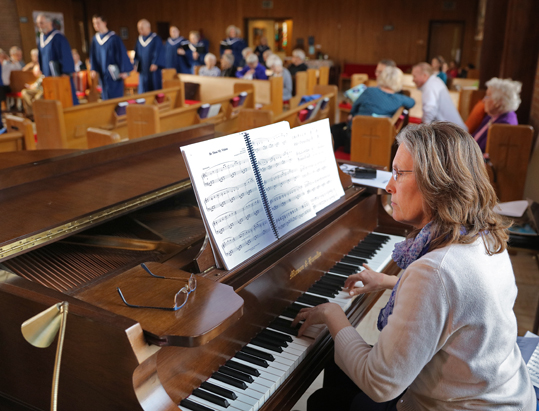
Lake Nokomis Presbyterian was dying, and everybody knew it — even if they weren’t quite ready to accept it. When Root realized the congregation wasn’t willing to let go — at least not yet — she knew it was the right place and the right time to suggest something radical.
“The people who had stayed were hardy adventurers,” she said. “They were ready to try new things. And I figured that if we went broke in 18 months instead of 24, what difference would it make?”
What would the circumstances have to be in order for your church or organization to make radical changes?
Strictly speaking, Root’s idea wasn’t new. In fact, it was thousands of years old. In a time when congregations are searching for new and different ways of being church, Root proposed that Lake Nokomis reclaim the ancient practice of Sabbath keeping and place it at the core of their identity as a congregation.
That might mean a day with no shopping trip to the mall. No pulling out a smartphone to check on work emails. No paying bills or balancing the checkbook.
And on some Sundays, under Root’s proposal, it would mean not even going to church.
“People weren’t coming every Sunday, anyway,” Root said.
A changed worship schedule
After a period of discernment, the congregation agreed to change its worship schedule and place Sabbath keeping at the heart of its life together.

Now, six and a half years later, the pattern they established is a strong, sustaining rhythm. On the first and third Sundays of the month, Lake Nokomis holds traditional worship services. On the alternate weekends, members gather on Saturday evenings for contemplative services that draw upon the same Scripture and sermon as the previous Sunday’s worship.
And on the second and fourth Sundays each month? They practice Sabbath, taking a rest from work, obligations, and even formal worship itself.
“I sleep in,” said Sue Goodspeed, a member of the worship committee. “I don’t get to do that often.”
Lisa Larges settles down with a cup of coffee and the Sunday edition of The New York Times. “I read the whole thing,” she said.

In months that have five Sundays, the congregation spends the extra Sunday participating in a community outreach event with a local nonprofit that offers mental health and educational services to children with emotional and behavioral issues.
The worship schedule is altered for holidays. Next Sunday may be the fourth Sunday in March — normally a Sabbath day at the church — but it will still be Easter at Lake Nokomis Presbyterian.
“Of course, we’re going to have services on Easter,” Root said.
How can your congregation keep Sunday worship from being “just another obligation?”
Nobody at the church is required to practice Sabbath, and though most congregants have readily joined in since the beginning, some are still less than enthusiastic. Dick Gross, a 50-year member, skips the Saturday services because it means driving after dark, and he misses the opportunity to worship on those weekends.
“To me, church is Sunday morning,” he said.
But having watched the congregation shrink over the years, he also appreciates the logic behind the changes.
“It seems to work for the younger people,” he said.

The decline reversed
Lake Nokomis Presbyterian is not on the cusp of becoming a megachurch, by any means, but the attendance trend has been reversed. Since the Sabbath practice was launched, the congregation has gained 18 new members and another dozen or so people who attend regularly. About 90 people are now members of the church; 40 to 70 attend Sunday worship services, and 12 to 25 the Saturday evening services.
Young families have joined the church, and the children’s program is back. “It’s great seeing kids running around the church again,” Root said.

And the church’s financial situation has improved. In fact, it donates 10 percent of its annual budget to neighborhood projects.
“One of the big questions for us was, how could we be a blessing for others,” Root said. “We’re financially stable. We’re just as much in the hole as we were before, but at least we’re not going any deeper.”
One of the biggest challenges for Lake Nokomis members has been how to explain Sabbath keeping to people outside the church. After spending a Sunday in retreat from the many obligations of modern life, members are often bombarded with questions:
“Why didn’t you return my phone call about the Monday meeting?”
“How could you not finish that PowerPoint presentation?”
“What do you mean your kid isn’t coming to soccer practice?”
A countercultural practice
That’s not surprising, said Dorothy C. Bass, the recently retired director of the Valparaiso Project on the Education and Formation of People in Faith and author of “Receiving the Day: Christian Practices for Opening the Gift of Time,” a book about Sabbath practices.
Practicing Sabbath is very countercultural, Bass said.
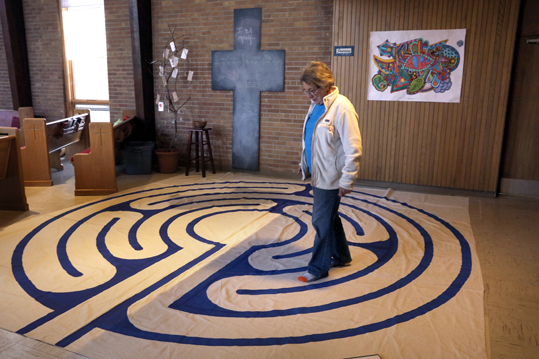
“The ethos of society now is hectic,” she said. “We’re obsessed with productivity in a way that infuses most people’s consciousness. … This has become so habitual that we don’t even realize how broken we are.”
In what ways does your congregation challenge cultural understandings of productivity and busyness? In what ways does it affirm them?
Root knows firsthand the knee-jerk guilt of breaking with societal norms. The first Sunday the church observed Sabbath, she and her family went for a walk through their neighborhood.
“We went past a church, and when I saw the parking lot full of cars, I felt like I was playing hooky,” she said.
The cultural ramifications are one reason that Bass was excited to hear about Lake Nokomis Presbyterian and its journey together. Many individuals have taken up Sabbath keeping in recent years, but it is rare for an entire congregation to take such significant steps to encourage one another in the practice, she said.
“Doing it collectively, communally, with somebody else — that’s why it’s really cool that a congregation is taking this on,” she said. “I don’t know of any individual who can say, ‘I’m going to grant myself this freedom.’ No, we’re going to need to do that with and for each other.”
The renewed interest in Sabbath practices among Christians started to surface about 20 years ago. Bass wrote her book in 2000; since then, the need for Sabbath has only grown stronger.
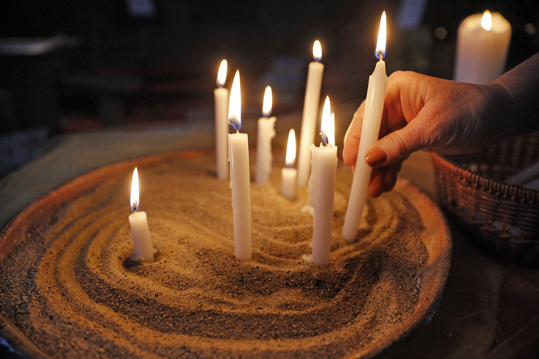
“I think the practice is more needed now than it was then,” Bass said. “We’ve lost touch with natural time. Now we have Internet time, which governs the economy and is 365, 24/7. I don’t think that’s the way we were meant to be as human beings.”
Sabbath at Lake Nokomis
At Lake Nokomis Presbyterian, the Sabbath Sundays are set aside “for rest and play, being instead of doing, connecting with God and others, and embracing the world with awareness and gratitude.”
Exactly what that entails is left up to each individual or family, but the church doesn’t recommend that participants drop off the radar completely, Root said. She suggests drawing a line between obligations and desires: do what you want to do, not what you feel that you have to do.
Members vary widely in how they make that distinction. Sabbath, like art, can be in the eye of the beholder. What one person considers a chore — spending hours in the kitchen preparing an elaborate meal, for instance, or toiling on one’s hands and knees tending a garden — is someone else’s notion of a perfect day.
“We have members who mow their lawn on Sundays,” Root said. “They like doing it.”
Youth sports are a typical source of conflict, even for Root and her family. With two children, the family came up with a rule to address the issue.
“If it’s a game, it’s fun, and we go,” she said. “If it’s a practice, it’s an obligation, and we don’t go.”
Not everything is that cut-and-dried, of course. Member Andy Cochrane focuses on not worrying about work.
“I’m not always successful,” he admitted. “But even if I don’t make it all day, doing it part of the day helps.”

Practicing Sabbath has had a profound effect on Root and her family, Root said.
“I’ll never forget what that first day felt like,” she said. “It felt like it was an eighth day. It felt like a gift. It gave me a palpable feeling of peaceful energy.”
Taking an entire day off ran counter to everything she’d ever experienced.
“I come from a robust line of multitaskers,” she said. “I was always trying to put 10 pounds in a 5-pound box. Now I’m focused on putting 5 pounds in a 5-pound box.”
Goofing off, good for the soul
Most of what the church members do on the Sabbath could be described as good, old-fashioned goofing off. That’s fine, Bass said. Goofing off can be good for the soul and the body. It’s not just common sense; the Bible actually calls for rest.
“It still is one of the Ten Commandments,” Bass said.
“It’s OK just to rest,” she said. “I believe that you can’t get through a week without having some type of Sabbath. Your body will break.”
In her book, Bass examined the theological, biblical and sociological influences on Sabbath and found three general approaches to the Christian Sabbath.
One is to celebrate creation. “It says in Genesis that God rested on the seventh day and looked at everything he did, and it was good,” she said.
Another focuses on liberation. “In Deuteronomy, it says ‘The Lord your God led you out of slavery.'”

The third involves being part of a community that commemorates the resurrection. “So get outdoors and celebrate creation. Do something that feels free and life-giving, and get together with people,” Bass said. “I like to say, ‘No church meetings [on the Sabbath], but church picnics are great.'”
What would an ideal Sabbath look like for you?
The Lake Nokomis congregation took to the Sabbath practice quickly. It was proposed as a one-year experiment, but “six months into it, we had changed so much that there was no going back,” Root said. She knew how deeply the practice had taken hold in the church when she sent an email to a member and got a note back chastising her for sending it on a Sunday afternoon.
Saturday services
The inauguration of the alternate-weekend Saturday evening services didn’t go nearly as smoothly — to put it mildly. The long periods of silence in the contemplative-style services left many members uncomfortable and fidgety.
“The first service was a disaster,” Root said. “It was almost painful. I came out of there saying, ‘This is not going to fly.'”
But they kept refining it until it did fly, bringing together pieces from the Sunday morning service, meditative elements from the Taizé community and the self-directed features of contemplative spirituality.
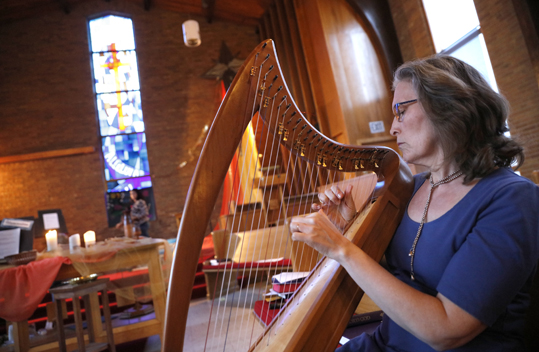
The hour-long service begins with Root speaking to the assembled membership, offering an abridged version of the previous Sunday’s sermon. Then the group breaks up. While music director Jeanne Rylander softly plucks a harp, some people meditate. Others visit various stations, where they can, for example, pray for troubled parts of the world, walk a labyrinth or simply rest. At one station, adults and children can color a banner that later will be hung in the church.
The Saturday evening program has enabled the congregation to reach out to worshippers who want something different from a traditional worship service but still like the direction that clergy can offer.
“We’re not a one-size-fits-all church,” Goodspeed said.
Even though the Saturday service repeats the Scripture and part of the sermon from the previous Sunday, some members like the different approaches so much that they attend both.
“I feel that I get something different out of it,” Larges said. “We hear the same Scripture, but we hear it in different ways.”
Ultimately, Root said, the goal of the Saturday services and the Sabbath practices is the same.
“Find ways you and God can commune,” she told the congregation on the eve of a recent Sabbath Sunday observation.
“If you stop, God will come to you,” she said. “You will experience something significant. And even if it happens on just one day, it will be worth it.”
Questions to consider
Questions to consider
- What is the most radical and beneficial change you could envision your church or organization making? What would the circumstances have to be in order to make those changes?
- What is the core of your congregation’s identity?
- In what ways, if any, can Sunday worship become just one more obligation on a list of obligations? How can your congregation keep Sunday worship from being “just another obligation?”
- How does your congregation challenge cultural understandings of productivity and busyness? How does it affirm them? How can your congregation help members realize their brokenness and rethink those and other cultural assumptions?
- What activities and obligations would you give up if you were to practice Sabbath? What would an ideal Sabbath look like for you?
I still remember the first time I had to speak in front of an audience. It was in seventh grade. I was just giving a simple introduction for my school’s choir, yet my hands were shaking so much that the words on the notecard blurred to create something akin to an original Jackson Pollock.
Fast-forward to high school, and the fear was still with me. I remember the terror and frustration in my poor partner’s eyes when I forgot all the lyrics to our duet, “Anything You Can Do, I Can Do Better.” On the upside, our performance finally solved that debate: anything I could do, she clearly could do better!
And yet, of all things, improv comedy — a practice that requires presence on a stage — came to me like manna in my ministry desert.
In 2009, a month after my ordination to the priesthood, on the heels of some major staffing cutbacks, my boss and would-be mentor was removed for sexual misconduct. Shortly after that, the senior associate priest took a leave of absence to care for her husband, who had been diagnosed with Alzheimer’s.
I believe the technical ecclesial term for my circumstance at that time would be “messed up.”
Since then, I have come to enjoy watching for the next “top 10 list” of risk factors for clergy burnout, because I have faced almost all of them. Despite the care and support I received at the time from my diocese and my congregation, I privately felt overwhelmed. I didn’t want to give up my ministry, but I began to believe that it was inevitable, that burnout was both a logical and a foregone conclusion.
Pastors don’t talk about it much, but my guess is that most of us have secret moments when we feel like giving up. The pressures of isolation, expectation and failure wear on even the most pious of souls. Whoever said that it’s lonely at the top should try standing behind an altar.
In that season of my ministry, facing crushing responsibility and self-doubt, I wanted to quit. And then an idea struck me, as if the heavens opened and a great voice spoke:
“Dude, you need a hobby.”
Vocations are great; they can be life-giving. But on some level, I knew that if I couldn’t get my head out of the church drama, the drama would consume me. I needed something that I did just for the love of it. I needed people in my life who knew me as a priest but didn’t see me as their priest.
Finding a hobby was a challenge in itself. I was in the ordination process for 10 years as I grew into adulthood; it had become the center of my identity. I was so desperate, I had to think all the way back to an improv class I had taken in middle school to get an idea of something to try.
Improv was a highly unlikely choice for me, not just because of my fear of being the center of attention. I am an Episcopalian: spontaneity is our natural enemy. We pride ourselves on burying our noses in the Book of Common Prayer — not for saying, off the cuff, “I just want to praise God for this” or “I just want to pray for that.”
What surprised me, when I began taking classes in improv, was that I had found not just a hobby but a powerful practice for my ministry and leadership.
There is only one universal doctrine in the improv community. It is often referred to as a rule, but it is more like a vow than a law. I would call it a rule of life, but more accurately it is a rule of play. The rule can be summed up as “yes, and.” I have never seen so much packed into two simple words.
The improv “yes” says that everything that happens is a gift to be received. You don’t fight to undo, redefine or control what your scene partners are doing. You accept it. Period.
And then you have to do something with it. It is on you to say not just “yes” but “yes, and.”
Your partner says, “Let’s go to the zoo.” You can say, “The penguins are my favorite! Let’s take my DeLorean. ” You cannot say, “There are no zoos here on the moon,” because that would be heretical; that would be a denial of the basic reality your scene partner has lovingly given you.
Following this rule of play onstage creates a place where all voices are heard, loved and respected, and it leads to a level of justice and creativity that I’ve yet to find in church or in any other corner of the world. At its most basic, “yes, and” is just about lovingly working together, which is apparently so rare in our world that when you put it onstage it is funny.
This concept now informs everything about how I practice ministry. It has healed resentments, blessed us with laughter and led my communities to do some beautifully creative things, like an original children’s book stewardship campaign and an annual holy-water squirt gun fight. But before it could change what I do, it had to change how I see.
With time and practice, I came to realize that what improvisers call “yes, and” is actually something definitive about our Christian tradition that I am embarrassed to say I really didn’t understand before. It is grace.
The God of the Bible is an improviser. That is the only explanation for the way God hangs in with us through our ups and our downs. When Adam and Eve discover shame and try to cover their nakedness, God accepts that they no longer fit in the garden. God says “yes, and” by clothing them for their journey.
When the people cry that a woman should be stoned, rather than screaming “no,” Jesus says, “Yes, and whoever is without sin, go ahead.” The cross itself represents how we try to kill love, compassion, healing and God himself, and God says, “Yes, you can do that, and I will bring resurrection.”
I try not to be too hard on myself that I really didn’t understand grace while I was in seminary, because I simply didn’t. I hadn’t practiced it. This is what we do in improv. We practice grace.
Here is the trick with grace, though: you have to keep practicing. I practice with my improvisers at least once a week and perform once a month. I don’t claim to be good at it, but I know it is good for me.
The practice of “yes, and” helps me see differently. It gives life and humor to our vestry meetings. It helps me see signs of healing in the middle of an alcoholic’s relapse. I thought that church drama would be the end of my priesthood, and in some ways, it was. Through improv, the priesthood I thought I had ended, but the one God was playing me into began. A more humble, less controlling, more grateful priesthood. A priesthood that says “yes, and” to the challenges and is marked with the courage it takes to allow my shaky, nervous self to be seen.
This priesthood, centered in a rule of play, is focused not on prescriptions or successful planning but on acting in the moment with grace.
God’s grace is so radical that we can’t understand it without practicing it. Even now, I struggle to explain grace, because it is a mystery. What I have found, though, is that while grace cannot be explained, it can be played.
I long to see our churches as places where we don’t just learn about sin and forgiveness and make friends but where we embrace our God-given rule of play — where we come to know grace because we practice it.
At a conference I attended last year, Richard Foster, the Quaker spiritual writer and author of “Celebration of Discipline,” spoke on the perils of modern technology and media. Afterward, Nathan Foster, his son, interviewed him onstage and, between gentle, repeated proddings (“come on, Dad”), drew out a confession that only a son could: Richard Foster, spiritual sage, likes to watch “M*A*S*H” reruns on television.
For the audience, the news wasn’t shocking but humanizing. We were relieved to know that the man who champions spiritual discipline doesn’t spend every night meditating. Moreover, he might actually celebrate the discipline of slacking off.
If Richard Foster watches “M*A*S*H,” then maybe Ann Voskamp relaxes with “Grand Theft Auto” and a shot of whiskey. Maybe Rick Warren plays “Donkey Kong,” N.T. Wright rides a dirt bike on the Scottish moors, and Lauren Winner puffs a cigar. Surely, the leaders who spend their lives preaching and writing about Christian purpose deserve a break, right? And what about the rest of us, the ground troops carrying out their calls to action?
Today the cry from some pulpits is that Western Christians are complacent. They supposedly lack vision. They have no sense of how to live, how to spend their time or how to serve the world around them.
But even if some churchgoers are not living missionally, many others are, and they face a very different problem. I see them all around me — people who feel stressed out, overworked and underplayed. The moments they squander are not a sign of laziness or complacency but a fitting response to the call to Sabbath.
It’s taken me years to learn this lesson and apply it in my own life.
I grew up as the child of Quaker missionaries to Kenya. When we came back stateside, my parents carried their missionary zeal right into suburbia. They fostered kids from all over the world who came to the United States for medical help, opened our house to others as a space of counseling and community, and sent us on mission trips to Mexico.
When I went off to college, I carried the torch. I taught Sunday school to junior high kids from broken homes and journeyed with a suicidal sex-abuse victim who lived in my dorm. I worked consecutive summers with children whose families were on welfare, Latino kids from low-income homes and babies with AIDS in the slums of Nairobi.
Then in my early 20s, I hit a faith crisis, and suddenly all my acts of service felt pointless. The world itself seemed like an empty expanse left behind by a careless God. Why try?
I left the church and spent two years distancing myself from anything that smelled of Christian meaning. Frankly, I felt tortured the entire time. Somewhere in the recesses of my heart I knew that doing absolutely nothing of ultimate purpose wasn’t the answer either.
When I returned to the church at age 25, I swung back to the same extreme I’d started with in college. As if doing penance for my two wasted years, I slept on a hard cot in the church choir room as part of a homeless ministry and stayed up past midnight for months editing a documentary about the civil war in Sudan. I was determined to save the world.
Now, as a 30-something wife and mother, my life is not nearly as interesting as it used to be. Instead of sleeping with the homeless under a church roof, my husband and I do ministry out of our home by welcoming the disenfranchised in our lives, especially my husband’s college students.
They send text messages asking, “What do you do when you feel forgotten by God?” In the evenings, they come to our house for coffee. We listen to their questions about faith, and then at bedtime bow our heads in prayer, hand them their leather jackets and walk them out the door.
For us, the tough question has not been identifying how to serve but how to stop. Fortunately, we’re working out a response, day by day.
We practice Sabbath on Saturdays. We balance nights of activity with “down” nights. Many evenings, we turn off email and phones and do something that I — like Foster — am embarrassed to admit: watch TV. I’m embarrassed, I think, because somewhere deep down I think my life is purposeful only if I’m slopping gruel into bowls for hungry orphans or doing something comparably dramatic.
For the most part, I’m still the same person I was at age 22 — hopefully more mature, but still at heart a radical who’s desperate for restoration and doesn’t trust God to get the job done. The Sabbath, then, is the only thing between me and madness. It’s a safety net catching and cradling me above the mile-deep canyon where I could easily find myself in free fall, dropping into the very darkness that I’m trying to rid the world of.
This year, we’ll start taking our 5-year-old, Madeline, to serve at Church Under the Bridge, a worship service for the homeless and others. She’s the kind of child who’ll beg to bring everyone back to our house for a sleepover. She’ll want to give them doughnuts and crayons and old coats, and in her face I’ll see a nascent compassion that terrifies me because I know that someday it might catapult her into a faith crisis.
Why don’t they have houses, mom? she’ll ask. Where are their mommies?
My daughter, like me, will someday be susceptible to the well-meaning rhetoric of the New Radicals and other Christian leaders who call us to do more, sacrifice more and give more. Their call is justified. But for overzealous college students, overworked clergy and even those of us with mediocre service records, the call to ministry should be balanced by a countercall to the spiritual discipline of rest.
For some, the Sabbath may not make for a soul-stirring message. But I need to hear it preached from the pulpit and see it modeled for my kids and for me. I need to be reminded that on judgment day we are more likely to be held accountable for thinking too much of ourselves and our modest accomplishments than for squandering time.
In my own day-to-day routine now, I’m trying to rest. Trying to practice Sabbath. Inhabit it. Enjoy it. Commit to it as part of holy living.
On any given night when I turn on the TV, Richard Foster may be watching “M*A*S*H” in the mountains of Colorado. In some strange way, he and I are affirming the sovereignty of God. We’re taking the long view. Balancing the Great Commission with Ecclesiastes. Trusting that God alone is capable of redeeming the world to shalom.